
PICKING UP THE PIECES
Exploring Reconstruction through Literature
Introduction | Background Knowledge | Activities | Extensions | Standards
Introduction
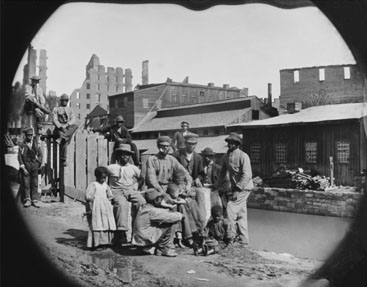
Years before the Civil War, Abraham Lincoln famously said that “a house divided against itself cannot stand.” That house fell during the Civil War. In the years after General Robert E. Lee surrendered at Appomattox Court House, the government had to figure out how to pick up the pieces of the fallen house. President Lincoln had set the stage for the reconciliation that would come to be known as Reconstruction. With Lincoln’s assassination, President Andrew Johnson would be charged with bringing the former Confederate states back into the Union.
Background Knowledge
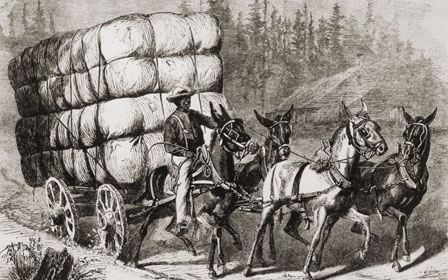
At the end of the Civil War, the United States faced the huge challenge of reuniting the nation. This era, from 1865 to 1877, is known as Reconstruction. Reconstruction was an unsettled time of change. The first hurdle that the US faced was how to readmit the seceded states into the Union. Lincoln did not believe that the Southern states had actually left the United States, so he did not believe that they had to be readmitted. This philosophical difference led to many political disagreements. In 1863, the Wade-Davis bill was introduced and passed by both chambers of Congress. This bill required citizens to take an “Ironclad Oath” proclaiming that they never supported the Confederacy, which was too stringent for Lincoln, and he vetoed the bill. The Reconstruction Acts, passed in 1867 and 1868, allowed all seceded states to reenter the Union under strict conditions requiring them to rewrite their constitutions. These acts were vetoed by President Andrew Johnson, but Congress overrode the veto, and the legislation passed.
Protection for freedmen was also a challenge during the Reconstruction Era. In March 1865, the Freedmen's Bureau was founded to help freedmen establish their lives after slavery. They helped with basic needs - food, clothing, and shelter - as well as with labor contracts and with negotiating new relationships between former slaves and those who enslaved them. Born in North Carolina, President Johnson did not believe that Blacks should be involved in government and did not intervene when the Southern States began implementing Black Codes to replace their “slave codes.” The Black Codes of the Reconstruction Era were short-lived, but set up a culture of white political dominance in the South. President Johnson also blocked the passage of the 14th Amendment, which would add protections of the Civil Rights Act to the Constitution.
Andrew Johnson was widely seen as an ineffective president and was replaced by General Ulysses S. Grant in the Election of 1868, who won 52.7% of the popular vote. Grant went to work quickly by admitting 4 Southern states back to the Union and verifying that their state constitutions protected voting rights for all African-American as well as white men. Grant also pushed Congress to pass the Enforcement Acts of 1870 and 1871, which sought to protect people of African descent and support the Reconstruction governments in the Southern states. In addition, he created the Department of Justice and supported it as it prosecuted the Ku Klux Klan.
One of the most significant pieces of legislation of the Reconstruction Era was the 14th Amendment, ratified in 1868. This amendment gave equal protection under the law to all citizens and defined citizenship. It overturned the Dred Scott decision of 1857, which denied citizenship to people of African descent. It also reversed the ⅗ compromise, which counted enslaved people as ⅗ of a person for representation in Congress. Finally, the third section banned anyone who participated in an insurrection against the Constitution from holding office.
Another significant piece of legislation was the Fifteenth Amendment, passed in 1870, which ensured that men of all races were eligible to vote. However, this amendment did not protect these new voters from the barriers that made it difficult or impossible for men of African descent to vote, such as poll taxes or literacy tests.
As the Reconstruction Era came to a close, the country's political landscape was in transition. The political ideologies of the 1870s were starting to shift. Southern states continued to suppress and oppress African Americans, while Northern states grew weary of the government's involvement in Reconstruction. With the contested Election of 1876, Rutherford B. Hayes was elected president. The federal troops charged with overseeing Reconstruction in the South stood down, and government involvement waned, ending the Reconstruction Era.
ACTIVITIES
Selective List of Picture Books
-
Ellen's Broom by Kelly Starling Lyons (ISBN 9780399250033)
- The Civil War is over, and Ellen's parents can go to the courthouse to have their marriage recognized in the eyes of the law. Mama tells the story of jumping the broom, and they decide to bring the broom with them to the courthouse. Ellen makes the broom a special part of the ceremony and the family. It is a great book about traditions.
- Use this discussion and activity guide to discuss the book in-depth and have students create their own brooms.
- Extend the story with Reader's Theater by Debbie Gonzales.
- Learn more about the Freedmen's Bureau and Marriage Records from the National Archives.
-
The Amazing Age of John Roy Lynch by Chris Barton (ISBN 9780802853790)
- John Roy Lynch was born "half Irish and all slave." During the Reconstruction, Lynch was elected to the House of Representatives and worked for equal rights for all people. This story is a well-written biography about John Roy Lynch.
- Discuss Lynch and his life's journey with this guide.
- John Roy Lynch was not the first or only African American to be elected to Congress. Learn more about some other trailblazers in this video from PBS.
- The House of Representatives keeps a biography of anyone who has served. Read John Roy Lynch's biography and create a timeline of his life.
- Technology Option: Create a digital timeline using TimelineJS (reviewed here) or another timeline resource from this list.
- Non-Technology Option: Students can work in small groups and use bulletin board paper to create large timelines. Each student can use a different color ink to contribute to the timeline so teachers can easily see each child's contribution.
-
Abe Lincoln's Dream by Lane Smith (ISBN 9781596436084)
- Quincy meets Abraham Lincoln's ghost while on a trip to the White House. The restless spirit says that "there was a lot to be done after 1865." Quincy takes him to see the state of America, and Lincoln expresses how much work he wanted to do.
-
This book encourages reflection on the Reconstruction Era. Students can write about what they would tell Abraham Lincoln about America. How would they answer Lincoln's questions?
- Technology Option: Create a video using Adobe Express Video Maker (reviewed here) so students can be the voice of Abraham Lincoln. They can upload a photograph of Lincoln from Pixabay (reviewed here) and then record their thoughts as a voiceover. Students can also create the portraits linked below and upload pictures of the finished product.
- Non-Technology Option: Students can create portraits of Abraham Lincoln and attach their writing to their pictures.
-
No Small Potatoes: Junius G. Groves and His Kingdom in Kansas by Tonya Bolden (ISBN 9780385752763)
- Born into slavery in Kentucky, Junius G. Groves walked to Kansas to begin life as a free man. He started small, with only a few leased acres to farm. From there, he grew his farm until he was able to buy his own farm. He found himself about $1400 short and worked with dedication and perseverance to work off his debt in a year. He built his life by farming potatoes and left a legacy for his family.
- Talk about how choosing a name or legalizing marriage was an expression of freedom.
- Junius G. Groves was an Exoduster. Examine primary sources from the Library of Congress using the Primary Source Analysis Tool (reviewed here).
- The Nicodemus National Historic Site in Kansas has photographs and videos that tell more about the Exoduster movement.
- Encourage cross-curricular learning with this learning guide.
-
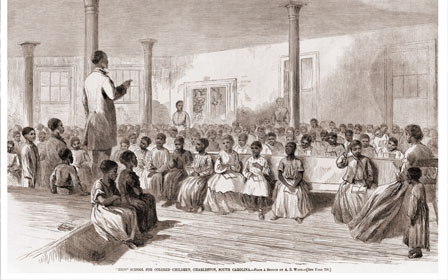
Freedom's School by Lesa Cline-Ransom (ISBN 9781423161035)
- After Lizze's parents "woke up" free from slavery, she and her brother have the opportunity to go to school. When they arrive one day to see the school on fire, they sadly return home. A few weeks later, the community comes together to rebuild.
- Encyclopedia Virginia gives excellent information, including photographs and a timeline, about education in Virginia during Reconstruction. The New Georgia Encyclopedia and the NCPedia also provide information and pictures.
- Tolson's Chapel, located in Maryland at the Antietam National Battlefield, served as a Freedmen’s School. Learn more about its history and role in public education by reading this article.
Selective List of Chapter Books
-
Forty Acres and Maybe a Mule by Harriette Gillem Robinet (ISBN 9780689833175)
- Two young brothers, recently freed from slavery, seek the forty acres and a maybe a mule that the Freedmen's Bureau is advertising. As they settle into their new lives, the Klu Klux Klan threatens their freedom, their safety, and their peace.
- The publisher created a discussion guide that includes activities and opportunities for further research.
- Learn more about General Sherman's plan to lease the freed slaves forty acres of land with the opportunity for purchase in this video from PBS.
- After the Civil War, many newly freed people looked for family members that had been separated. Last Seen is a nonprofit that studies the stories of families that were torn apart by the slave trade.
-
Brotherhood by Anne Westrick (ISBN 9780142422373)
- Shad lives in Richmond, Virginia. The Civil War has ended and Richmond is occupied by Union forces as Reconstruction begins. Shad and all of the males in his family are part of the Brotherhood or Klu Klux Klan. He believes in his family and the South, but also questions the Cause and his place in the Brotherhood. Set in the South and from a Southern perspective, this book represents the views and opinions of the time but allows the reader to feel Shad's internal conflict as he questions what he has always known.
- Best for mature 5th graders and above
-
A.B. Westrick, the author, provides a guided inquiry of Reconstruction using primary sources and the writer's workshop model. It is cross-curricular and encourages students to think critically about what they are seeing.
- Technology Approach - Use Marq (reviewed here) to publish the articles that the students write.
- Non-Technology Approach - Use paper and pencil, writing notebooks, and printed copies of the primary sources.
-
The author also provides a discussion guide to help facilitate a class discussion.
Virtual Field Trips
- National Constitution Center
- The Reconstruction in Virginia
-
The Museum of the Reconstruction Era in the Woodrow Wilson Family Home
- The virtual visit is compatible with Virtual Reality Goggles.
Videos to Watch
- Overview of Reconstruction by Bow Tie Guy and Wife
- Why Study Reconstruction by Facing History (scroll down the page to view this video)
- The World the War Made by Facing History (the video is part of a lesson plan on this page)
EXTENSIONS
-
Connect to Primary Sources
- The NIH and Smithsonian Learning Lab (reviewed here) have teamed up to create National History Day: Reconstruction, a collection focused on Reconstruction. Geared for middle school and up, elementary teachers can use appropriate parts of the resource to fit their students and curriculum.
-
Imagining Reconstruction Monuments
- In this Project Based Learning activity, students can identify an individual or event that played a significant role in reuniting the nation, helping it heal, and moving forward recognizing its newest citizens. Once chosen, students can draft sketches or use clay to create a statue to be a new monument.
-
Music in the Reconstruction Era
- The Fisk Jubilee Singers were founded in 1871 and shared "slave songs" with the world and helped solidify the genre of Negro Spirituals. Discuss the music as well as the legacy of the ensemble, which is discussed briefly in this video. The Library of Congress gives more information about Negro Spirituals and provides titles of the most well-known of the genre.
- The National Endowment for the Humanities created an EDSITEment site about African American Music. There are great resources and information housed here.
-
Mock Diary Entries
- Have students write a journal from the perspective of an everyday person during this era (e.g., a freedman, a northern teacher, or a southern farmer), describing their hopes for the future and how they define freedom. Use journal templates available from Canva for Education (reviewed here) or Genially (reviewed here) for students to write their journals and add multimedia items such as videos and audio recordings.
-
Thinking Routines
- Use Project Zero Thinking Routines (reviewed here) to help students explore different perspectives, such as newly freed Americans, poor white southerners, women, white supremacist groups, politicians, and others.
-
Video Presentations
- Bring students’ storytelling and journals to life using video creation tools like Invideo AI (reviewed here) and Mootion (reviewed here). These easy-to-use tools let users enter a script and then use AI to turn their ideas into short videos.
CORRELATION TO STANDARDS
-
AASL National School Library Standards
- Inquire Shared Foundation, Think Domain - Learners display curiosity and initiative by:
- 1. Formulating questions about a personal interest or a curricular topic.
- 2. Recalling prior and background knowledge as context for new meaning
-
Inquire Shared Foundation, Share Domain - Learners adapt, communicate, and exchange learning products with others in a cycle that includes:
- 1. Interacting with content presented by others.
- 2. Providing constructive feedback.
- 3. Acting on feedback to improve.
- 4. Sharing products with an authentic audience.
-
Include Shared Foundation, Share Domain - Learners exhibit empathy with and tolerance for diverse ideas by:
- 1. Engaging in informed conversation and active debate.
- 2. Contributing to discussions in which multiple viewpoints on a topic are expressed.
-
Include Shared Foundation, Grow Domain - Learners demonstrate empathy and equity in knowledge building within the global learning community by:
- 1. Seeking interactions with a range of learners.
-
Engage Shared Foundation, Think Domain: Learners follow ethical and legal guidelines for gathering and using information by:
- 1. Responsibly applying information, technology, and media to learning.
- 2. Understanding the ethical use of information, technology, and media.
-
Engage Shared Foundation, Create Domain: Learners use valid information and reasoned conclusions to make ethical decisions in the creation of knowledge by:
- 1. Ethically using and reproducing others’ work.
- 2. Acknowledging authorship and demonstrating respect for the intellectual property of others.
- 3. Including elements in personal-knowledge products that allow others to credit content appropriately.
-
Engage Shared Foundation, Grow Domain: Learners engage with information to extend personal learning by:
- 1. Personalizing their use of information and information technologies.
- 2. Reflecting on the process of ethical generation of knowledge.
- 3. Inspiring others to engage in safe, responsible, ethical, and legal information behaviors.
-
Collaborate Shared Foundation, Think Domain - Learners identify collaborative opportunities by:
- 1. Demonstrating their desire to broaden and deepen understandings.
- 2. Developing new understandings through engagement in a learning group.
- 3. Deciding to solve problems informed by group interaction.
-
Collaborate Shared Foundation, Create Domain - Learners participate in personal, social, and intellectual networks by:
- 1. Using a variety of communication tools and resources.
- 2. Establishing connections with other learners to build on their own prior knowledge and create new knowledge.
-
Collaborate Shared Foundation, Grow Domain - Learners actively participate with others in learning situations by:
- 2. Recognizing learning as a social responsibility.
-
Explore Shared Foundation, Think Domain - Learners develop and satisfy personal curiosity by:
- 1. Reading widely and deeply in multiple formats and writing and creating for a variety of purposes.
-
Explore Shared Foundation, Create Domain - Learners construct new knowledge by:
- 1. Problem solving through cycles of design, implementation, and reflection.
-
Explore Shared Foundation, Share Domain - Learners engage with the learning community by:
- 3. Collaboratively identifying innovative solutions to a challenge or problem.
-
Explore Shared Foundation, Grow Domain - Learners develop through experience and reflection by:
- 1. Iteratively responding to challenges.
- 2. Recognizing capabilities and skills that can be developed, improved, and expanded.
- 3. Open-mindedly accepting feedback for positive and constructive growth.
-
ISTE Standards for Students
-
Empowered Learner 1.1
- 1.1.b. Students build networks and customize their learning environments in ways that support the learning process.
- 1.1.c. Students use technology to seek feedback that informs and improves their practice and to demonstrate their learning in a variety of ways.
-
Digital Citizen 1.2
- 1.2.c. Demonstrate an understanding of and respect for the rights and obligations of using and sharing intellectual property.
-
Knowledge Constructor 1.3
- 1.3.d. Students build knowledge by actively exploring real-world issues and problems, developing ideas and theories, and pursuing answers and solutions.
-
Innovative Designer 1.4
- 1.4.d. Students exhibit a tolerance for ambiguity, perseverance, and the capacity to work with open-ended problems.
-
Global Collaborator 1.7
- 1.7.c. Students contribute constructively to project teams, assuming various roles and responsibilities to work effectively toward a common goal.
-
Empowered Learner 1.1
- Inquire Shared Foundation, Think Domain - Learners display curiosity and initiative by: