

On May 28, 1937, President Franklin D. Roosevelt pressed a telegraph key in the White House to declare the Golden Gate Bridge “open to the entire world.” Automobiles rolled across a 4,200-foot span that engineers once said couldn’t be built. This May, that moment turns 89 years old—making now a perfect time to hand your students a pile of popsicle sticks, a roll of tape, and a problem that won’t solve itself.
Bridge-building is one of the oldest — and richest — maker challenges in the educator’s toolkit. It brings together physics, geometry, materials science, teamwork, iterative design, and real aesthetic decision-making. Whether you teach kindergarteners or AP Physics, whether you have a full makerspace or just a table and a budget of $5, there is a bridge challenge for your classroom.
Before students can design a bridge, they need to understand the problem engineers faced. Share these facts as a hook — they reliably generate questions that lead directly into engineering thinking.
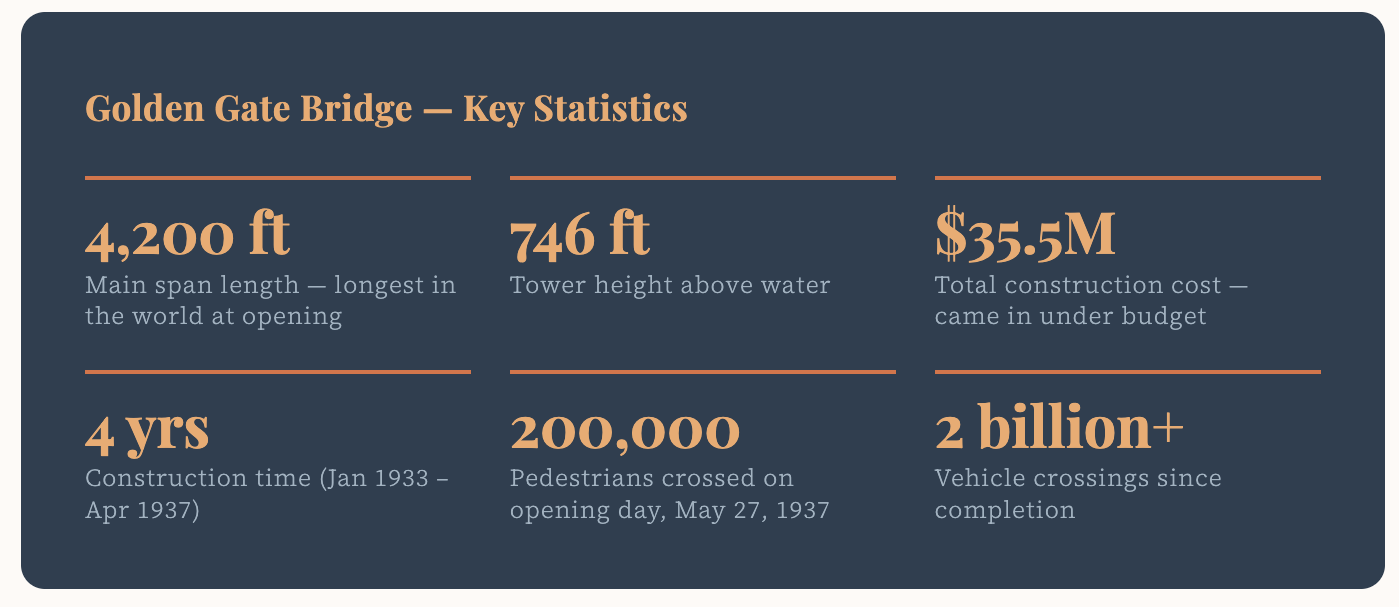
The Timeline: From Impossible Dream to Wonder of the World
1872 — The Idea
The concept of bridging the Golden Gate Strait is first proposed — and widely dismissed as impossible.
1921 — A Proposal
Engineer Joseph Strauss submits a preliminary design costing $27 million. Public opinion begins to shift.
January 5, 1933 — Breaking Ground
Construction begins at the depths of the Great Depression. Workers blast rock 65 feet below water to set earthquake-proof foundations.
May 27, 1937 — Pedestrian Day
18,000 people are already in line at 6 a.m. By day’s end, 200,000 have walked the span — some running, some roller-skating, one on stilts.
May 28, 1937 — Open to Traffic (89 Years Ago)
President Roosevelt telegraphs the order from the White House, and the first cars roll across. The bridge is declared “open to the entire world.”
Classroom connection: Ask students — what does it take to build something everyone said was impossible? What problems did the engineers have to solve before they could even start designing?
Bridge-building isn’t just a fun Friday afternoon activity (though it absolutely is that). It’s one of the most curriculum-connected maker challenges available to educators across grade levels and subjects.
- It teaches real engineering process. Students can’t wing it. They define the problem, research bridge types, design before they build, test, fail, analyze, and iterate. This is exactly the engineering design process — and students experience it authentically, not abstractly.
- It makes physics tactile. Tension, compression, load distribution, and structural failure stop being vocabulary words and become things students can see, feel, and sometimes dramatically observe when their bridge gives way under a stack of textbooks. The concepts stick.
- It scales. A kindergartner can build a bridge from blocks to see if it holds a toy car. A middle schooler can calculate load ratios. A high school student can analyze truss geometry mathematically. Same core challenge, enormous range of depth.
- It’s genuinely interdisciplinary. History (who built the Golden Gate Bridge and why?), economics (it came in under budget — how?), art and design (why is it painted International Orange?), mathematics (geometry, ratios, force calculations), and ELA (persuasive writing: which bridge design should our city choose?) all connect naturally.
- It connects to real careers. Civil engineers, structural engineers, architects, urban planners, and construction managers — the Golden Gate Bridge employed all of them. Use this moment to show students what these careers look like in practice.
Let’s look at bridge challenges for every grade and budget. From a five-minute warm-up using a single sheet of paper to a multi-week design-build-test project, there is a challenge here for every classroom context. All are grounded in engineering design process principles and making.
K–3
The Paper Bridge Penny Test
3–6
Option 1: Straw Suspension Bridge
Option 2: Straw Suspension Bridge 2
5–8
Popsicle Stick Bridge Challenge
6–12
Bridge Engineering Design Challenge
All Grades
Golden Gate Bridge Crafts
A lower-prep, higher-chaos favorite: teams build bridges using only dry spaghetti, masking tape, and marshmallows. Constraints include a minimum span distance and a load test. Great for introducing iterative design in a single class period with minimal materials cost. Have more time? Keep the same materials and add a redesign round after testing.
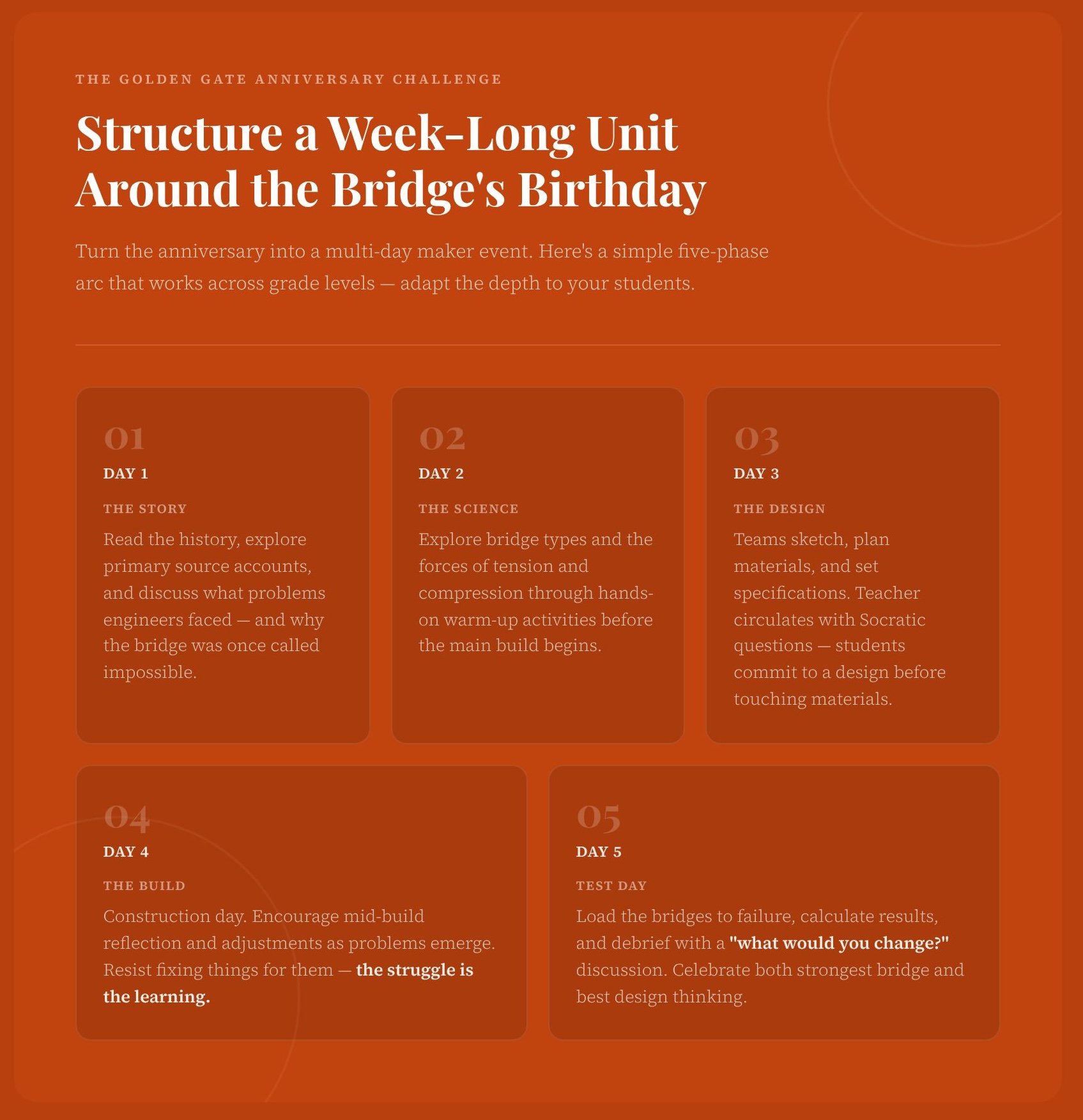
Strong maker activities aren’t just about building — they’re about thinking. Use these questions before, during, and after your bridge challenge.
Before you build: What is a bridge really trying to do? What forces does it have to overcome? Why would anyone in the 1930s say the Golden Gate couldn’t be built — and what changed their minds? If you had to cross a mile-wide channel with strong currents, dense fog, and earthquake risk, what would you need to know before you started designing?
During the build: What’s going wrong, and why? What would you change if you could start over? Where is your design under the most stress? How is your team making decisions when you disagree?
After the test: What did failure teach you that success couldn’t? If this were a real bridge with real people crossing it, what would have gone differently in your design process? The Golden Gate Bridge came in under budget and ahead of schedule — what does that tell us about how the engineers planned? How does an engineer decide when something is “good enough”?
Looking for a way to make the activities cross-curricular? Link the theme to social studies and history. The Golden Gate Bridge was built during the Great Depression, providing thousands of jobs at a time of national crisis. Explore the political, economic, and social conditions that made the project possible — and what it meant to the people who built it. Eleven men died during construction; their stories raise powerful questions about labor, risk, and the human cost of large infrastructure projects.
For language arts links, have students write a persuasive memo to a fictional city council, arguing for a specific bridge design, or a first-person historical narrative from the perspective of a construction worker, engineer, or one of the 18,000 people waiting in line at 6 a.m. on May 27, 1937.
Linking to art and design is easy! The Golden Gate’s distinctive “International Orange” color was chosen by architectural designer Irving Morrow, who felt it would stand out against the surrounding landscape and fog. That decision wasn’t just aesthetic—it was functional. Have students explore the intersection of engineering and design: why does the visual design of infrastructure matter? How do color, shape, and visibility influence safety and use? Have them design the color scheme and visual identity for their own bridge before building it.
Math is another natural fit. Calculate the strength-to-weight ratio of completed bridges. Explore the geometry of suspension cables (catenary curves). Investigate scale: if your popsicle bridge represents the Golden Gate at a 1:1000 scale, how long should it be? How tall should the towers be? Even simple measurements and comparisons can turn testing results into real mathematical thinking.
Happy 89th Anniversary, Golden Gate Bridge! Check out TeachersFirst for more resources and blog posts related to making. May your students build something that surprises them — and may they learn more from the moments it collapses than from the moments it holds.