
THE BRITISH ARE COMING!
Using Literature to Bring the American Revolution to Life
Introduction | Background Knowledge | Activities | Extensions | Standards
Introduction
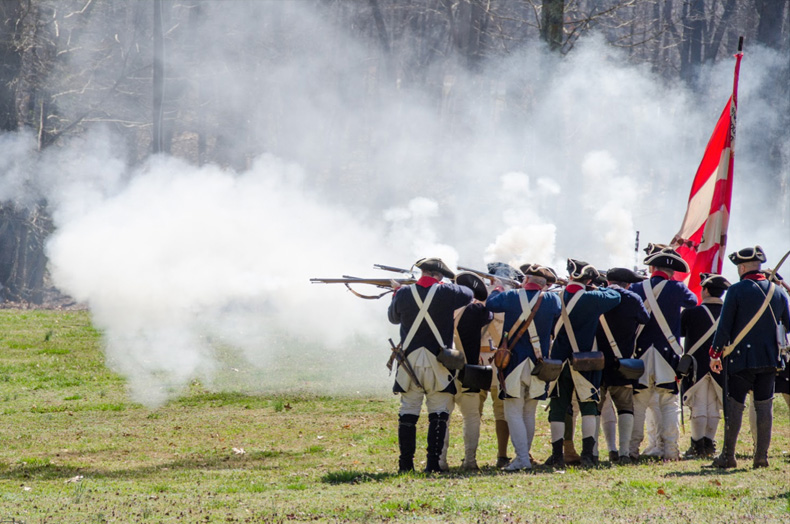
April 18, 1775. Lexington, Massachusetts. On that night, the “shot heard round the world” rang out, lighting the fuse of revolution. July 4, 1776. The thirteen colonies, united as the Continental Congress, declared independence from England, and the United States of America was born. For eight long years, the Sons of Liberty and the Patriots went to war with the strongest army in the world. They fought for freedom and then won.
Background Knowledge
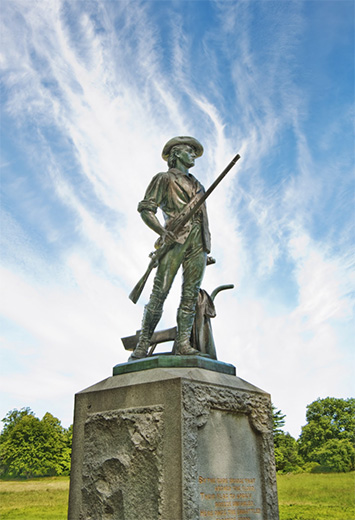
The American Revolutionary War was the culmination of years of conflict between England and its colonies in America. Beginning with Lexington and Concord in 1775 and ending with Yorktown in 1781, the Colonies fought for freedom from England. For many students, history is nothing more than dates and battles and names of people. Literature can bring history to life for students. Historical fiction can help students relate to the people who were living during the period. Poetry can evoke emotion and transport students into a different time and place. Nonfiction will provide information about the dates, battles, and generals and encourage students to draw conclusions about who the people were and how they felt as the world around them turned upside down.
ACTIVITIES
Selective List of Picture Books
- Colonial Voices: Hear Them Speak by Kay Winters (ISBN 9780525478720)
- A young boy named Ethan delivers messages on the eve of the Boston Tea Party. As he travels around town, he speaks to the citizens of Boston. Each person that Ethan meets gives a different perspective of England’s taxes.
- After reading, explore the different trades. The Colonial Williamsburg Foundation and Mr.Nussbaum.com both offer more information about colonial trades. Students can research the various trades and present their findings through a Wax Museum or other live display or can create a digital display using Microsoft Sway (TeachersFirst Review) or Powtoon (TeachersFirst Review)
- Visit the National Freedom Trail Tour virtually. Students can earn the virtual Junior Ranger Badge by visiting the affiliated sites and completing the downloadable book. A printable badge is available, or teachers can email the staff for the actual badges once supplies are renewed.
- Let It Begin Here! By Dennis Brindell Fradin (ISBN 9780802797117)
- This book brings the reader to Lexington and Concord and the first shots of the Revolutionary War. It begins when Paul Revere is dispatched to tell Samuel Adams and John Hancock that the British are coming and then goes on to Concord to warn the Minutemen there. It ends with the British retreat to Boston almost 24 hours later.
- Students can practice elapsed time with Judy clocks or paper plate clocks. For a technology option, use this online time duration calculator.
- Students can organize their thoughts and the sequencing of events by creating timelines. They can use paper and pencil for a non-technology approach or an online timeline creator like Sutori (TeachersFirst Review) for a technology option.
- Revolutionary Friends by Selene Castrovilla (ISBN 9781590788806)
- General George Washington and the Marquis de Lafayette worked together to win the Revolutionary War and help the United States of America win freedom from England. Throughout the process, they became good friends. The story is interspersed with French phrases and quotes from Lafayette.
- Students can learn more about this friendship and the Marquis de Lafayette from major historical sites in the United States.
- The Scarlet Stocking Spy by Trinka Hakes Noble (ISBN 9781585362301)
- The Revolutionary War effort extended well beyond the front lines. Seemingly innocent and uninvolved citizens supported the troops by passing messages. Maddie Rose used her stockings on her clothesline to pass the positions and movements of ships in the harbor to her brother. He would come surrounded by darkness to see the code and pass the information on.
- This book lends itself well to STEM activities, one of which is described here.
- A Teacher’s Guide is available that links to writing and other activities to support and extend the book.
- They Called Her Molly Pitcher by Anne Rockwell (ISBN 9780553112535)
- Molly Hays followed her husband into war. She lived with him at camp and tried to make his life easier. During the summer Battle of Monmouth, she ran around the battlefield with a pitcher of water, helping to keep the soldiers cool and hydrated. When General Charles Lee ordered a retreat, many men chose to fight on. Molly joined her husband and helped him fire the cannon. General Washington learned of her bravery and made her a sergeant in the Continental Army.
- Students can read more about Molly Pitcher here.
- Redcoats and Petticoats by Katherine Kirkpatrick (ISBN 9781718089211)
- Thomas missed his father. He had been taken away by the British and was told to take care of his mother. His mother kept sending him to go fishing and to look for a boat. These fishing trips took him past a British camp. As his mother hung out the laundry, he related what he saw each day.
- Read more about the Culper Spy Ring here and more about women who spied in the Revolutionary War here.
- The Library of Congress has a Breakout Box activity that practices using the Culpeper Code. Make it a technology option by putting the activity into Google Slides.
- John, Paul, George & Ben by Lane Smith (ISBN 9780786848935)
- The Fab Four of the American Revolution, John Hancock, Paul Revere, George Washington, and Benjamin Franklin were influential Founding Fathers and Sons of Liberty.
- This book lends itself to writing. Students can write a skit that incorporates each of the famous Americans. They can perform their original writing for their classmates or create a video using tools like Animatron (TeachersFirst Review).
- George vs. George by Rosalyn Schanzer (ISBN 9781426300424)
- George Washington and King George III are common names to scholars of the Revolutionary War. One is hailed as the hero, and one is reviled as the villain. This book looks at the two Georges and examines the Revolutionary War from both perspectives. It will encourage students to see the War from both sides.
- Create a Venn Diagram to compare and contrast George Washington and George III. Use paper and pencil for a non-technology option or use Venn Diagram Creator on Canva (TeacherFirst Review)
- Katie’s Trunk by Ann Turner (ISBN 9780689810541)
- Katie lives in a Loyalist family during the Revolutionary War. She does not understand why her neighbors are turning on her family. When a band of Patriots raid her house, Katie hides in her trunk, hoping nobody finds her. This is a great book to start a discussion about the opposing sides of the war.
- The American Independence Museum has a curriculum guide to accompany the book. It includes various activities, including a mind map, a pro/con list, and a letter to the Patriot neighbor. There are also resources to allow for further research about Loyalists and Patriots.
- An additional follow-up activity could be a “What Would You Do?” activity. Students would be given a scenario, or even create one themselves, and then describe how they would escape; this written assignment could also include a drawing to illustrate using Imagine Forest (TeachersFirst Review).
Selective List of Chapter Books
- I Survived the American Revolution, 1776 by Lauren Tarshis (ISBN 9780545919739)
- The 15th book in the popular I Survived Series; this book brings readers into Nathaniel Fox’s America. At 11 years old, he finds himself in the middle of a Revolutionary War battle. He lives with his uncle, who makes him work until he is exhausted. He runs away from home and runs into a battle in New York City.
- Extend the book with a Virtual Field Trip! Author Lauren Tarshis leads a 25 minute virtual field trip to the Museum of the American Revolution in Philadelphia, Pennsylvania. Teachers can download a classroom kit, which includes vocabulary and discussion questions.
- Further, extend with an article from Storyworks that is available on the virtual field trip page. This article is available in 4 grade/Lexile levels. The link will take you to the Grade 4/5 (780L)
- Revolutionary War on Wednesday by Mary Pope Osborne (Magic Tree House Series #22) (ISBN 9780679890683)
- Jack and Annie, the heroes of the Magic Tree House, arrive on the banks of the Delaware River on a cold December night. George Washington is considering staying in camp because of the weather. Jack and Annie have to make sure he crosses the Delaware. Students could generate a “What If?” list showing the implications of staying or going and then pairing scenarios in the format alternating the options using Presentious (TeachersFirst Review) or another slides-style presentation app.
- Pair this fiction book with its nonfiction companion guide - American Revolution by Mary Pope Osborne. (ISBN 9780375823794). Learn more about the events leading to The Coming to the American Revolution 1764-1776.
- Chains series (Chains (ISBN 9781416905868), Forge (ISBN 9781416961451), and Ashes (ISBN 9781416961475) by Laurie Halse Anderson
- This trilogy follows Isabel, an enslaved African-American, during the Revolutionary War. The amazing story is interspersed with historical facts and events that will captivate readers.
- Students can identify a historical event in the books and research it more thoroughly. They can present their findings in traditional non-technology ways like posters or written reports. For a technology approach, students can also curate resources about the historical event that they chose using Wakelet (Teacher First Review).
- Laurie Halse Anderson provides several teachers’ guides and resources to use with the Chains series.
Selective List of Virtual Field Trips

EXTENSIONS
- Bring in Primary Sources
- Students can learn a great deal from primary sources. The Library of Congress has a number of resources for the Revolutionary War, from paintings to speeches. Students can use the Primary Source Analysis Tool in their exploration.
-
How Can We Change History
- Invite your students to imagine what would happen if history took a different turn. What if George Washington had not crossed the Delaware? What if General Lee had not retreated at the Battle on Monmouth? What if France had not come to the Chesapeake Bay? Students can present an alternative outcome to historical events. Would the American Colonies still have won their freedom from England? What would current life be like if America was still a British colony?
CORRELATION TO STANDARDS
- AASL National School Library Standards
- Inquire Shared Foundation, Think Domain - Learners display curiosity and initiative by: 1. Formulating questions about a personal interest or a curricular topic. 2. Recalling prior and background knowledge as context for new meaning
- Inquire Shared Foundation, Grow Domain - Learners participate in an ongoing inquiry-based process by: 1. Continually seeking knowledge
- Include Shared Foundation, Create Domain - Learners adjust their awareness of the global learning community by:. 2. Evaluating a variety of perspectives during learning activities
- Include Shared Foundation, Grow Domain - Learners demonstrate empathy and equity in knowledge building within the global learning community by: 2. Demonstrating interest in other perspectives during learning activities
- Curate Shared Foundation, Create Domain - Learners gather information appropriate to the task by: 2. Collecting information representing diverse perspectives
- Explore Shared Foundation, Think Domain - Learners develop and satisfy personal curiosity by: 1. Reading widely and deeply in multiple formats and write and create for a variety of purposes. 2. Reflecting and questioning assumptions and possible misconceptions.
- Explore Shared Foundation, Share Domain - Learners engage with the learning community by: 1. Expressing curiosity about a topic of personal interest or curricular relevance
- ISTE Standards for Students
- Knowledge Constructor - 3d. Students build knowledge by actively exploring real-world issues and problems, developing ideas and theories and pursuing answers and solutions.