
406 physics results | sort by:
 return to subject listing
Stoichiometry of Chemical Reactions - Stoichiometry of Chemical Reactions
Grades
9 to 12
tag(s): periodic table (46), chemicals (37), equations (128)
In the Classroom
Students can use Padlet reviewed here to post questions or comments. Students can use Google Drawings reviewed here to post their chemical equations. Students can use Google Keep reviewed here to collaborative work on solving equations.You must be registered and logged in to add items to your favorites.
Use the form at the top of the page to log in, or click here to join TeachersFirst (it's free!).
String Theory - The Elegant Universe - PBS Nova
Grades
9 to 12Add your comments below (available only to members) | Become a Member
You must be registered and logged in to add items to your favorites.
Use the form at the top of the page to log in, or click here to join TeachersFirst (it's free!).
Study Stack - John Weidner
Grades
4 to 12tag(s): study aid (171), flash cards (44), greek (45), hebrew (17), latin (22), test prep (68), vocabulary (260)
In the Classroom
Encourage parents to use this site as a study-at-home tool for their students. Link your blog or website to this site by entering your url at the bottom of the homepage. Make sure your guidance counselor at your school is aware of this site as a tool for studying those college entrance tests. Be sure to save this site in your favorites.Add your comments below (available only to members) | Become a Member
You must be registered and logged in to add items to your favorites.
Use the form at the top of the page to log in, or click here to join TeachersFirst (it's free!).
Submarines, Secrets and Spies - PBS Nova
Grades
6 to 12tag(s): engineering (137)
In the Classroom
Although military ships are not a typical curriculum topic, teachers studying technology and engineering topics will want to consider this site as a "real world connection" to illustrate some of the applications of technology and physics, especially for your more concrete learners.Add your comments below (available only to members) | Become a Member
You must be registered and logged in to add items to your favorites.
Use the form at the top of the page to log in, or click here to join TeachersFirst (it's free!).
Summer Olympic Games Science - Home Science Tools
Grades
5 to 10tag(s): sports (108), STEM (393), gravity (55), olympics (65)
In the Classroom
Have students complete the reaction-time investigation in pairs, record at least three trials, and compare their average response times to see whether repeated practice improves them. Have small groups alter one variable in the reaction-time experiment, such as age, practice, or completing another task while catching, then graph their results with Infographic Presentation Templates, reviewed here and write a claim supported by evidence. Ask students to research an Olympic sport that involves rotation and create a labeled explanation with Google Drawings, reviewed here, showing the rotational axis, body position, and how angular momentum affects movement.Add your comments below (available only to members) | Become a Member
You must be registered and logged in to add items to your favorites.
Use the form at the top of the page to log in, or click here to join TeachersFirst (it's free!).
Summer Olympics - TeachersFirst
Grades
K to 12In the Classroom
This collection includes resources for all grades. Each review includes several ideas for classroom use. These are excellent tools to learn more about the history or science of the Olympics. Save (or bookmark) this list for students to use to review concepts. Explore the activities suggested.Add your comments below (available only to members) | Become a Member
You must be registered and logged in to add items to your favorites.
Use the form at the top of the page to log in, or click here to join TeachersFirst (it's free!).
Surfing Scientist - ABC Science
Grades
3 to 12tag(s): experiments (66)
In the Classroom
Use many of these resources for brain teasers, mind stretchers, or anticipatory sets to initiate class. Encourage students to brainstorm, explain, and even blog their reactions to these resources. Provide time for students to work out the science behind the demonstrations. Consider creating little podcasts using a site such as PodOmatic (reviewed here), with students demonstrating end explaining the science to show true understanding.Add your comments below (available only to members) | Become a Member
You must be registered and logged in to add items to your favorites.
Use the form at the top of the page to log in, or click here to join TeachersFirst (it's free!).
Surging Seas: Sea Level Risk Finder - Cimate Central
Grades
6 to 12tag(s): climate (100), climate change (115), earth day (68), earth (187), environment (248)
In the Classroom
Use this tool to discuss how climate change is affecting sea level, as well as other weather events that have been in the news. Be sure to talk about energy and how it is produced and why all combustion reactions produce carbon dioxide. Research the composition of the atmosphere and why changes in certain gases can cause such a problem. Be sure to have students check out the validity of different sources and sites for accuracy and statistics and data that backs up the viewpoint. Rather than scare students, discuss ways that everyone in the world can create a greener Earth for tomorrow. Challenge students to research and then create multimedia presentation using one of the many TeachersFirst Edge tools reviewed here. Some tool suggestions are (click on the tool name to access the review): Adobe Creative Cloud Express for Education, Vevox, Animatron, and Renderforest.Add your comments below (available only to members) | Become a Member
You must be registered and logged in to add items to your favorites.
Use the form at the top of the page to log in, or click here to join TeachersFirst (it's free!).
Sylvia's Super-Awesome Maker Show! - Sylvia Todd
Grades
5 to 12This site includes advertising.
tag(s): STEM (393), engineering (137), experiments (66), makerspace (41)
In the Classroom
A young female teen, science, and maker ed - the perfect ingredients to get girls interested in science! Sylvia's web shows could be an excellent "back door" to creating female student interest in science! Share videos with students as part of your plan to implement maker spaces in your classroom. Use Sylvia's presentations as a model, then have students create videos demonstrating classroom projects and experiments using a tool like Mootion, reviewed here, and then share them on a site such as TeacherTube, reviewed here. Have cooperative learning groups create podcasts demonstrating their experiments. Use a site such as podOmatic, reviewed here.Add your comments below (available only to members) | Become a Member
You must be registered and logged in to add items to your favorites.
Use the form at the top of the page to log in, or click here to join TeachersFirst (it's free!).
Symphony of Science - John Boswell
Grades
8 to 12This site includes advertising.
tag(s): space (249), life cycles (22), ecology (112), atoms (44), matter (51)
In the Classroom
Provide a link to the site on a classroom computer or class website. Introduce Big Ideas or themes in Science with one of the videos to encourage discussions and generate questions for research. Share the mashups on your interactive whiteboard or projector. Capitalize on gifted students' powerful sense of justice and concern about social issues and spark some truly creative music/science projects by sharing these examples in your gifted program.Add your comments below (available only to members) | Become a Member
You must be registered and logged in to add items to your favorites.
Use the form at the top of the page to log in, or click here to join TeachersFirst (it's free!).
Talks by Brilliant Women in STEM - TED Conferences, LLC
Grades
6 to 12tag(s): medicine (52), robotics (30), womenchangemaker (101), STEM (393)
In the Classroom
Use the playlist to introduce students to women in STEM careers and connect classroom topics to real-world research. Assign students one talk related to a current unit. After viewing, have them identify the speaker's field, the problem or question she explores, and the impact of her work. Students can compare two speakers and discuss how their education, interests, and experiences influenced their career path using Venn Diagram Creator by Canva, reviewed here. For a career exploration activity, ask students to select a speaker whose work interests them and research the education and skills needed to enter that field.Add your comments below (available only to members) | Become a Member
You must be registered and logged in to add items to your favorites.
Use the form at the top of the page to log in, or click here to join TeachersFirst (it's free!).
TEACHFLIX - Ditch That Textbook
Grades
K to 12tag(s): digital citizenship (113), engineering (137), STEM (393), problem solving (284), virtual field trips (154), social and emotional learning (236), coding (112), computers (101), computational thinking (44), noregistration (74)
In the Classroom
Use this curated collection of videos to engage students in lessons in all subjects. Use edpuzzle, reviewed here, to enhance the video content by adding comments, questions, and more within the video. Create interactive lessons with videos from this collection, formative assessments, and other interactive content using Pear Deck, reviewed here, to present material in a deeper, more robust manner. Upon completion of your lesson, extend learning by asking students to share their learning using a simple web page builder such as Straw.Page, reviewed here.Add your comments below (available only to members) | Become a Member
You must be registered and logged in to add items to your favorites.
Use the form at the top of the page to log in, or click here to join TeachersFirst (it's free!).
Teaching NGSS Engineering Design Through Media - PBS LearningMedia
Grades
K to 12tag(s): structures (15), energy (135), robotics (30), problem solving (284), STEM (393), architecture (81), engineering (137)
In the Classroom
Use this site on a projector or interactive whiteboard to discuss and informally assess prior knowledge as you start your study of many different STEM-based topics. Use this site for enrichment or to help non-readers understanding concepts through video. Include it on your class web page for students to access both in and out of class. Enhance learning and have students create a word cloud of the important terms they learn from this site using a tool such as WordItOut, reviewed here. To extend learning have students create a multimedia infographic sharing their findings using Canva Infographic Maker, reviewed here.Add your comments below (available only to members) | Become a Member
You must be registered and logged in to add items to your favorites.
Use the form at the top of the page to log in, or click here to join TeachersFirst (it's free!).
TED-ED - Ted.com
Grades
6 to 12tag(s): blended learning (30), religions (118), business (50), design (66), literature (215), psychology (61), Teacher Utilities (234)
In the Classroom
Choose a video or create your own videos for students to use for review. After students view a video that has the questions, show one that doesn't, and have students generate questions for it. Assign videos for students to view at home or in the computer lab. Use them as a springboard for engaging writing prompts or to spark a discussion connected with a unit of study. Challenge students to do a compare/contrast activity using an online Venn Diagram tool, reviewed here. Most of the videos are less than twenty minutes, which makes it realistic to use them in a one-period class lesson or if you are implementing blended learning or flipped learning in your classroom or school (leaving class time for asking questions and clarifying).Show a video or two with your class and discuss the set up of the lesson. Discuss the difference between basic comprehension questions and open-ended questions. Show your students an inspirational video or two from TED reviewed here. As a class, pick out eight or ten of the TED videos and allow students to sign up to work on one of the videos. Have cooperative learning groups develop a TED Ed video lesson. You will need to proofread all work using a word processor, before allowing students to upload their questions on TED Ed.
Add your comments below (available only to members) | Become a Member
You must be registered and logged in to add items to your favorites.
Use the form at the top of the page to log in, or click here to join TeachersFirst (it's free!).
Tesla - Master of Lightning - PBS
Grades
4 to 12tag(s): industrial revolution (21), motion (60), energy (135), radio (16), inventors and inventions (87), electricity (62)
In the Classroom
Add intrigue and mystery, to your science unit on electricity, motion, or inventors as you study the life and accomplishments of Nikola Tesla. Excellent lesson plans include a concrete understanding of potential energy, mechanical energy to electrical energy. Use on an interactive white board to begin your unit or create a "Who Dunnit" with electricity or radio. Follow the structure of ideas presented to create an online "famous scientist" wiki, blog or PowerPoint to add to your class website. Use a Socratic seminar to debate which scientist should get credit for the induction motor, radio, and even the Industrial Revolution. Use the readings for older students, advanced readers, or gifted students, as they are far above the reading level of elementary and early middle school students. In language arts, writing topics could include "What a shock electricity is in my life" and "Will the true inventor of electricity please stand up?" The ideas and resources are electrifying!Add your comments below (available only to members) | Become a Member
You must be registered and logged in to add items to your favorites.
Use the form at the top of the page to log in, or click here to join TeachersFirst (it's free!).
The Basics of Fusion - Princeton
Grades
6 to 12tag(s): energy (135), nuclear energy (20)
In the Classroom
In addition to its obvious applications in physics, this issue could have widespread economic and environmental implications. There are lots of "What if..." questions you could develop around this one.Add your comments below (available only to members) | Become a Member
You must be registered and logged in to add items to your favorites.
Use the form at the top of the page to log in, or click here to join TeachersFirst (it's free!).
The Bowers Institute: Design Challenge Learning - The Tech Museum of Innovation
Grades
2 to 12tag(s): human body (97), density (17), agriculture (52), friction (14), gravity (55), simple machines (22), heart (26), magnetism (40), plants (141), motion (60), forces (54), sound (71), energy (135), matter (51), architecture (81), commoncore (63)
In the Classroom
Take advantage of the many free lesson plans offered at Design Challenge Learning to teach science concepts. Create a class wiki with additional resources for experimenting with science. Not comfortable with wikis? Check out the TeachersFirst Wiki Walk-Through. Have cooperative learning groups create podcasts demonstrating their understanding of one of the concepts. Use a site such as podOmatic, reviewed here, and then post them on the wiki or on your class web page.Add your comments below (available only to members) | Become a Member
You must be registered and logged in to add items to your favorites.
Use the form at the top of the page to log in, or click here to join TeachersFirst (it's free!).
The Crash Course - Crash Course
Grades
4 to 12tag(s): civics (142), zoology (18), politics (122), branches of government (69), statistics (126), copyright (39), media literacy (140), myths and legends (42), literature (215), engineering (137), computers (101), energy (135), ecology (112), climate (100), business (50), space (249), plants (141), black history (132), human body (97), artificial intelligence (372)
In the Classroom
Introduce this site on your interactive whiteboard or with a projector. The site is excellent for introductory material on any topic you're starting and for giving students some background knowledge. Crash Course is also great for your early finishers. Allow them to choose a topic they want to investigate or know more about.Add your comments below (available only to members) | Become a Member
You must be registered and logged in to add items to your favorites.
Use the form at the top of the page to log in, or click here to join TeachersFirst (it's free!).
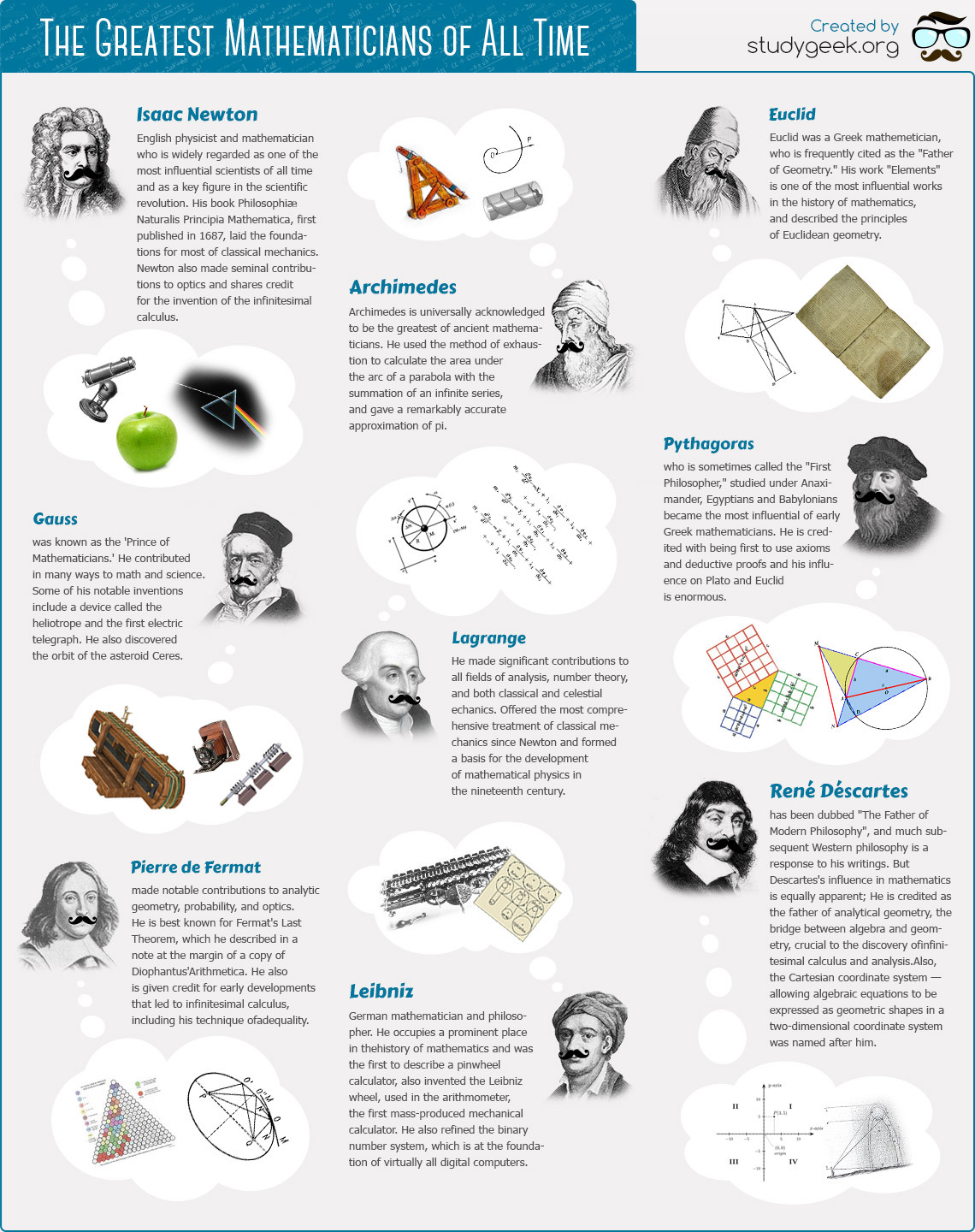
The Greatest Mathematicians of All Time - StudyGeek
Grades
6 to 12tag(s): biographies (103), famous people (39), pythagorean theorem (19), newton (25)
In the Classroom
Download this graphic and have it printed for use as a poster in your classroom. Display the graphic on your interactive whiteboard as an introduction to famous mathematicians. Have students research each mathematician and share their findings in presentations with a tool like Google Slides, reviewed here.Add your comments below (available only to members) | Become a Member
You must be registered and logged in to add items to your favorites.
Use the form at the top of the page to log in, or click here to join TeachersFirst (it's free!).
The Incredible Power of Concentration - Miyoko Shida
Grades
5 to 12This site includes advertising.
In the Classroom
First show this video on an Interactive Whiteboard (and projector) during a unit on Newton's laws and gravity and ask the students to identify how she does it. What do students notice and infer about the skill involved. Ask students to brainstorm where this example occurs in nature (students can bring in vacation photos or videos) or find images and other examples online. Encourage students to make their own demonstrations of center of gravity, recording them on video to share on the class website. Share them using a tool such as SchoolTube reviewed here.Add your comments below (available only to members) | Become a Member
You must be registered and logged in to add items to your favorites.
Use the form at the top of the page to log in, or click here to join TeachersFirst (it's free!).
Add your comments below (available only to members) | Become a Member
Close comment form